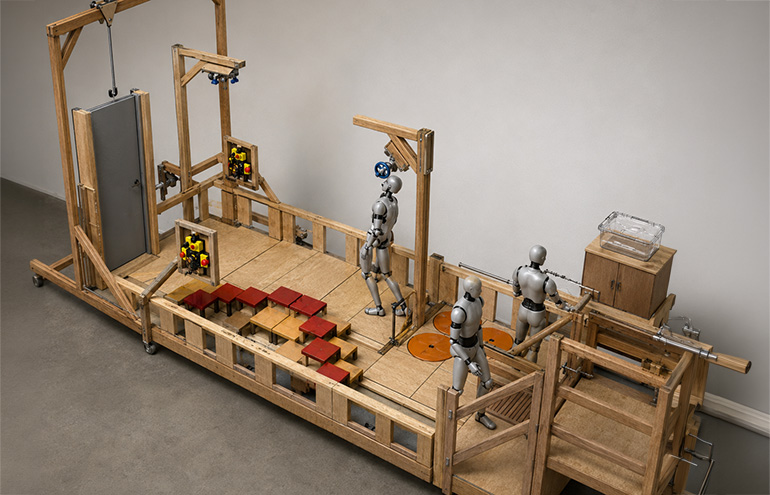
The National Institute for Standards and Technology (NIST) has unveiled a groundbreaking proposal for a standardized performance benchmark for humanoid robots, marking a pivotal development in robotics evaluation. This initiative, announced last month, is the first of its kind since the 2015 DARPA Robotics Challenge and aims to establish a comprehensive method for assessing the minimum expected physical capabilities of humanoid robots.
What Happened
NIST, based in Bethesda, Maryland, and part of the U.S. Department of Commerce, has introduced a proposed baseline performance benchmark to evaluate humanoid robots. This benchmark includes a "low-footprint set of locomotion and manipulation tasks" reflecting the minimum capabilities required for robots in industrial, household, healthcare, and other applications. The proposal builds on previous collaborations with the Defense Advanced Research Projects Agency (DARPA) and is intended to guide future development in both industry and academia.
The proposed benchmark will test various capabilities such as domain-agnostic mobility, manipulation/dexterity, coordinated capabilities combining locomotion and manipulation tasks, and whole-body awareness and control through confined-space manipulation tasks. The tasks also incorporate minimal reasoning, task and scene understanding, and decision-making capabilities.
NIST, in collaboration with industry and the research community, has developed an apparatus for testing these capabilities. The institute plans to distribute a limited number of these testing apparatuses for free to U.S. humanoid robot manufacturers and established regional testing facilities. Additionally, NIST will publish the designs and 3D models of the apparatus for use as a physical and/or virtual testbed for robot training and control development.
What This Means for Your Business
For AECM professionals and government contractors, this new benchmark presents significant implications for contracts and procurement. Companies that engage in the development or deployment of humanoid robots can leverage these benchmarks to enhance their product offerings and ensure compliance with emerging standards. This initiative also aligns with broader trends in the robotics industry, such as the Robotics Summit & Expo 2026, which highlights innovations and industry insights.
Is your firm ready for what’s next?
VisioneerIT helps AECM and government contractors modernize operations, achieve compliance, and implement AI.
Explore VisioneerIT Solutions →