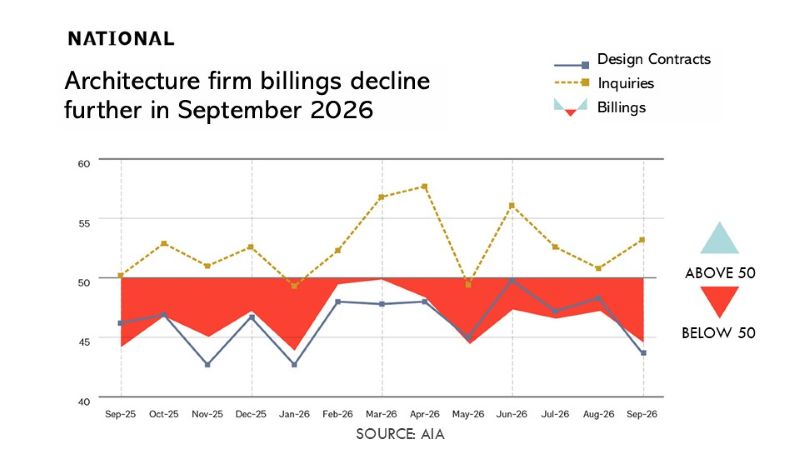
The American Institute of Architects (AIA) recently reported a further decline in the value of newly signed design contracts, with the Architecture Billings Index (ABI) for September 2026 recording a score of 44.7. This score indicates a contraction and represents a further weakening from the previous month. The ABI is a crucial economic indicator used to forecast nonresidential construction activity 9 to 12 months in advance, with scores below 50 signaling a downturn.
What Happened
The September 2026 ABI score of 44.7 highlights a challenging period for architecture firms in the U.S., as this figure reflects a broader trend of declining billings. The AIA reported that the greatest share of firms have seen declining billings since May 2026, despite a modest increase in project inquiries. While firm backlogs averaged 6.2 months at the end of the third quarter, they have decreased from 6.6 months earlier in the year. Notably, firms specializing in multifamily residential projects experienced the most significant backlog reduction, from 6.2 months in March to 4.8 months in September. Conversely, larger firms with annual billings exceeding $5 million maintained a steady backlog of 8.1 months, while small firms saw a slight increase from 3.1 months to 3.8 months.
Business conditions varied across the U.S., with the Northeast experiencing persistent softness, while firms in the West and Midwest reported stable billings. Commercial and industrial specialization firms noted slight growth for the second consecutive month. However, firms with institutional and multifamily residential specializations continued to report declining billings, marking six and five consecutive months of decreases, respectively.
What This Means for Your Business
For AECM industry professionals, these trends suggest a cautious approach to future planning and resource allocation. The decline in design contracts could impact procurement opportunities and project pipelines, especially for firms heavily invested in multifamily residential and institutional projects. Compliance with industry standards, such as the Cybersecurity Maturity Model Certification (CMMC) and adherence to evolving NIST guidelines, remains critical as firms navigate these challenging conditions. Additionally, firms should consider diversifying their portfolios to mitigate risks associated with sector-specific downturns.
Federal funding opportunities and competitive positioning could be influenced by these trends, as infrastructure investments and government contracts may provide a buffer against the downturn. Firms should closely monitor federal procurement windows and funding announcements to capitalize on potential growth areas.
What US Operators Should Watch
Decision-makers should keep a close eye on forthcoming federal deadlines and procurement opportunities that may arise as part of government efforts to stimulate the construction sector. Monitoring updates to the CMMC and NIST compliance requirements will be essential for maintaining eligibility for federal contracts. Additionally, tracking the ABI and other economic indicators will provide valuable insights into future market conditions and help inform strategic business decisions.
Source: https://www.metalconstructionnews.com/news/the-value-of-newly-signed-design-contracts-declines-further/. Read the original story ->
Partner Insight · VisioneerIT
The decline in design contracts highlights the importance of understanding federal procurement opportunities for architecture and construction firms. VisioneerIT can assist in navigating the complexities of government contracts and compliance standards to help firms secure vital projects.
Explore VisioneerIT Cybersecurity →
Is your firm ready for what’s next?
VisioneerIT helps AECM and government contractors modernize operations, achieve compliance, and implement AI.
Explore VisioneerIT Solutions →