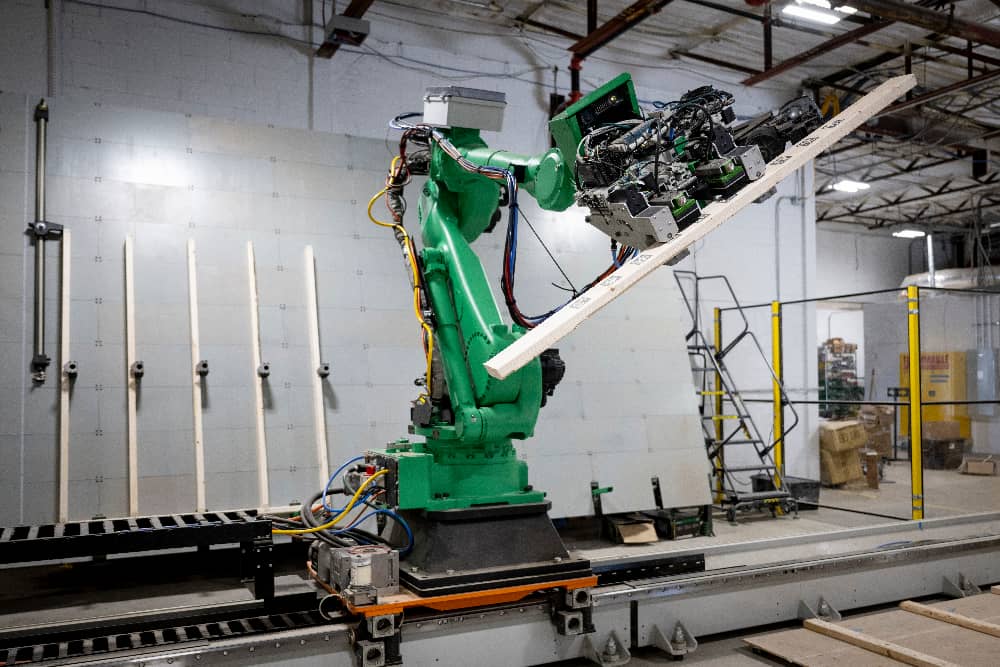
Reframe Systems, a startup founded by former Amazon Robotics executives, is making waves in the construction industry with its innovative approach to home-building. The company recently secured $40 million in equity financing to establish a second automated component factory in Massachusetts, aiming to accelerate and economize the construction process. This development is poised to significantly impact the construction sector, offering a faster and more cost-effective alternative to traditional methods.
What Happened
Reframe Systems is set to inaugurate its second microfactory, FAB1, in Billerica, Massachusetts, in October. This facility is designed to produce up to 500 multifamily units or 250 single-family homes annually. The company’s existing microfactory, FAB0, is located in Andover, Massachusetts. Reframe's innovative system uses robotic arms and software to automate repetitive tasks such as measuring, cutting, fastening, and material handling. The components are pre-assembled in the factory and then transported to construction sites for final assembly.
The microfactories are mobile and can be established in existing buildings of 50,000-70,000 square feet within 100 days at a cost of under $5 million. Reframe claims its system can build homes three times faster and 35% cheaper than traditional construction techniques. The company has completed 10 homes to date and plans to complete 114 by the end of 2026. One notable project is a wildfire-resilient bungalow in Altadena, California, built for a family who lost their home in the wildfires of January 2025.
What This Means for Your Business
For AECM professionals, Reframe Systems' approach offers a compelling proposition: reduced construction times and costs through automation and robotics. This could lead to significant savings in labor and materials, potentially increasing profit margins. Additionally, the ability to set up microfactories near construction sites can minimize logistics expenses and streamline supply chains. For government contractors, this efficient building method aligns with the increasing demand for rapid and sustainable housing solutions, providing a competitive edge in bidding for federal housing contracts.
What US Operators Should Watch
Industry stakeholders should monitor the operational success of Reframe’s FAB1 microfactory as it launches in October. Additionally, the company's goal to complete 114 homes by 2026 may set new benchmarks for project timelines and costs in the industry. Decision-makers should also track potential regulatory changes and compliance requirements for automated construction processes, as these could affect procurement strategies and project planning. Opportunities may arise for partnerships or investments in similar automated construction technologies as the market evolves.
Source: [Global Construction Review]. Read the original story ->
Is your firm ready for what’s next?
VisioneerIT helps AECM and government contractors modernize operations, achieve compliance, and implement AI.
Explore VisioneerIT Solutions →