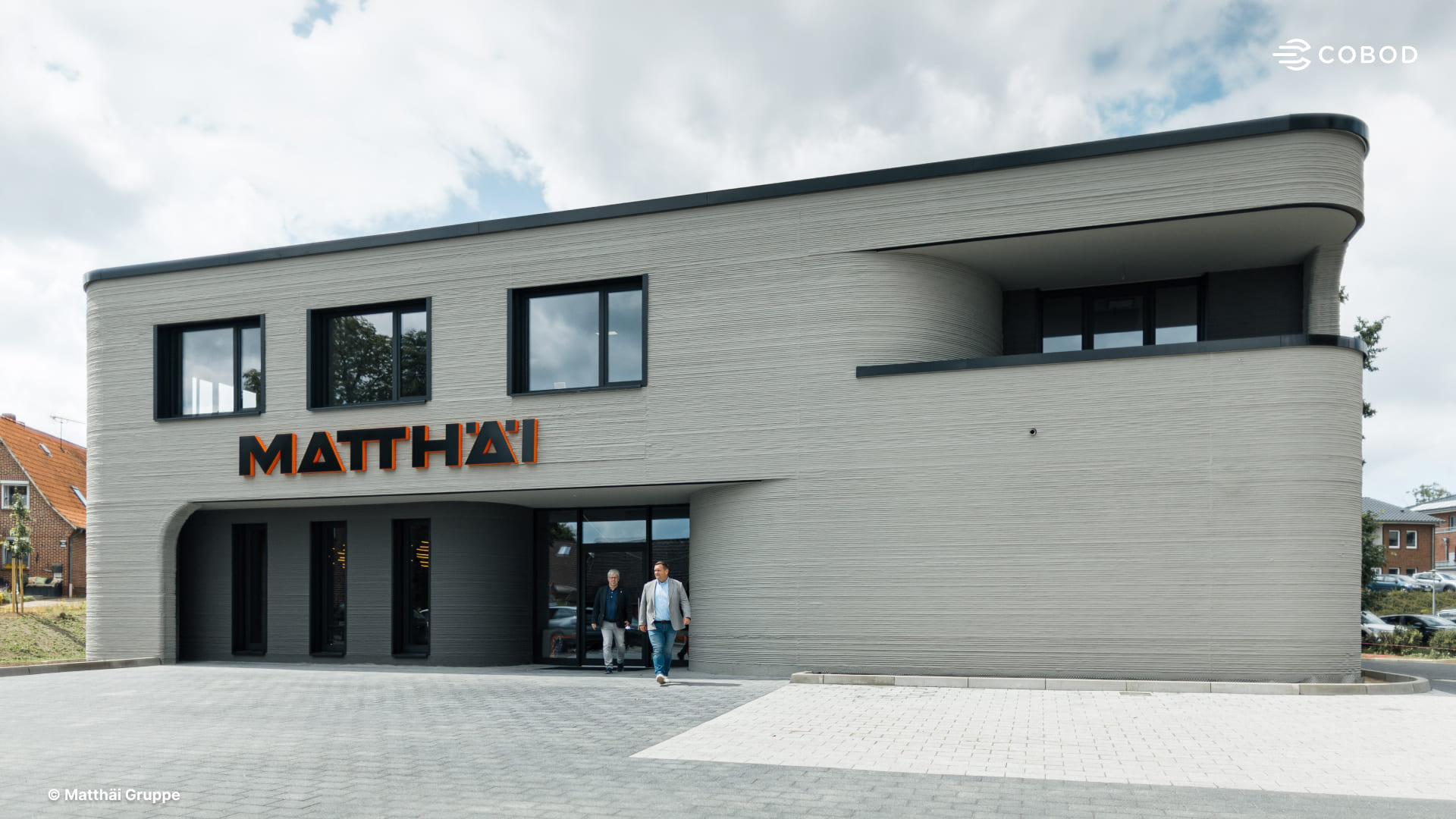
German construction engineering company Matthäi has completed a groundbreaking project by constructing a 364-square-meter, two-story headquarters in Selsingen, Lower Saxony, using a Cobod Bod2 3D printer. This project marks not only a significant technological achievement in construction but also the launch of Matthäi’s new printing division, signaling a shift towards innovative building methods that promise greater efficiency and sustainability.
What Happened
Matthäi's new headquarters stands as a testament to the capabilities of 3D concrete printing technology. The building's walls were erected using Holcim’s TectorPrint cementitious material, with the printing process taking a mere 105 hours. Unlike traditional construction, which requires formwork, the building's form was produced directly from a digital model, showcasing the speed and flexibility of 3D printing. While the foundation, base slab, floors, and roof were constructed using conventional methods, the walls demonstrate the potential of this technology to revolutionize construction.
Peri 3D Construction played a crucial role as the technology partner and supervisor during the printing phase, collaborating with architects from Schulenburg Architekten and planning firm Mense-Korte. The partnership has extended beyond this project, as Matthäi has launched a dedicated printing division in collaboration with Peri to explore further applications of 3D printing in construction.
Tim Schulenburg, managing director of Schulenburg Architekten, emphasized the transformative impact of this technology, stating, "3D concrete printing allows us to completely revolutionize traditional construction processes. As a company, we see in this innovation not only a technological advance but the creation of an entirely new sector within construction."
What This Means for Your Business
For AECM professionals, Matthäi's project exemplifies the potential for 3D printing to reduce construction time and costs while enhancing flexibility and sustainability. The establishment of a dedicated printing division highlights a strategic move to capitalize on this technology, which could lead to new business models and competitive advantages. Companies engaged in construction and engineering should consider investing in 3D printing capabilities to stay ahead in an industry increasingly driven by innovation.
Moreover, the collaboration with Peri and the use of advanced materials like Holcim’s TectorPrint cementitious material underscores the importance of partnerships and material innovation in realizing the full potential of 3D printing. As federal and state governments continue to emphasize sustainability and efficiency in infrastructure projects, businesses that adopt these technologies may find themselves better positioned to win contracts and meet compliance requirements.
What US Operators Should Watch
As the US construction industry continues to explore advanced manufacturing techniques, executives and decision-makers should monitor developments in 3D printing technology closely. The successful completion of projects like Matthäi’s headquarters could inspire similar initiatives stateside, potentially leading to new procurement opportunities and shifts in regulatory frameworks.
US operators should also keep an eye on potential changes in compliance standards that might arise as 3D printing becomes more prevalent. Engagement with technology partners and material suppliers could prove crucial in adapting to these changes and maintaining a competitive edge.
Source: https://www.globalconstructionreview.com/germanys-matthai-prints-headquarters-and-opens-new-division/. Read the original story ->
Is your firm ready for what’s next?
VisioneerIT helps AECM and government contractors modernize operations, achieve compliance, and implement AI.
Explore VisioneerIT Solutions →