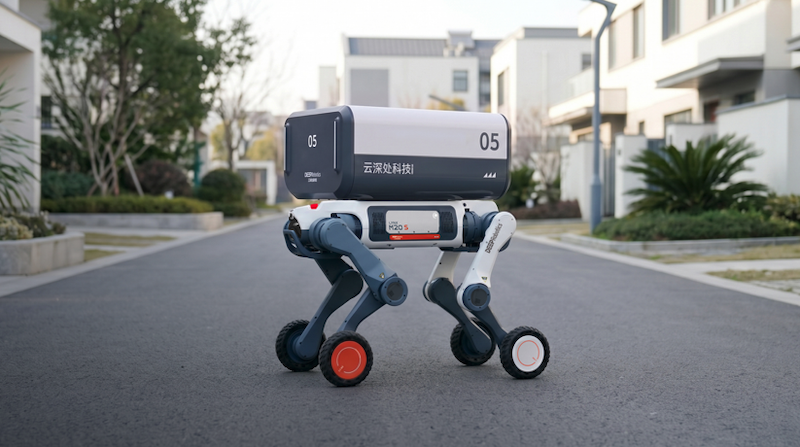
Deep Robotics has launched the Lynx M20S, a next-generation wheeled-legged robot poised to redefine standards in industrial inspection and emergency response. This development is particularly significant for industries reliant on robust and adaptable machinery to navigate complex and hazardous environments.
What Happened
Deep Robotics introduced the Lynx M20S as an advanced iteration of its predecessor, the Lynx M20. The M20S delivers substantial improvements in load capacity, protection, and speed, designed to enhance operational efficiency and adaptability across various industrial scenarios. The robot's design features a self-developed AI motion control algorithm, which allows it to dynamically adjust its posture and gait to tackle extreme terrains such as rugged mountain roads, muddy wetlands, and debris-strewn fields. Furthermore, its dual ultra-wide-angle LiDAR provides omnidirectional navigation and obstacle avoidance, ensuring high-precision autonomous positioning and intelligent path planning. With a dual-battery bay hot-swappable power system, the Lynx M20S promises rapid battery exchange and uninterrupted operation, enhancing long-term efficiency.
The robot's load capacity has seen a dramatic increase, reaching 35kg on flat terrain, which is 233% of the previous model's capacity. This allows the M20S to carry more modules for inspection and reconnaissance, expanding its versatility in fields like logistics, equipment mounting, and emergency material transfer. Its protection capabilities have been upgraded to an IP67 rating, allowing it to operate in water up to 1 meter deep for 30 minutes, and withstand harsh conditions such as heavy rain and high-pressure sprays. With an operating temperature range from -30°C to 55°C, the robot can function year-round in extreme climates. Additionally, its noise reduction to ≤55dB makes it suitable for low-noise environments.
Why It Matters for the AECM Industry
The introduction of the Lynx M20S is a pivotal development for the AECM industry, where the demand for versatile and efficient robotic solutions is growing. The robot's enhanced load capacity means it can handle a broader range of tasks, from transporting materials to conducting inspections in hard-to-reach areas, potentially reducing labor costs and increasing safety by minimizing human exposure to hazardous environments. Its advanced protection features and adaptability make it ideal for emergency res
Is your firm ready for what’s next?
VisioneerIT helps AECM and government contractors modernize operations, achieve compliance, and implement AI.
Explore VisioneerIT Solutions →