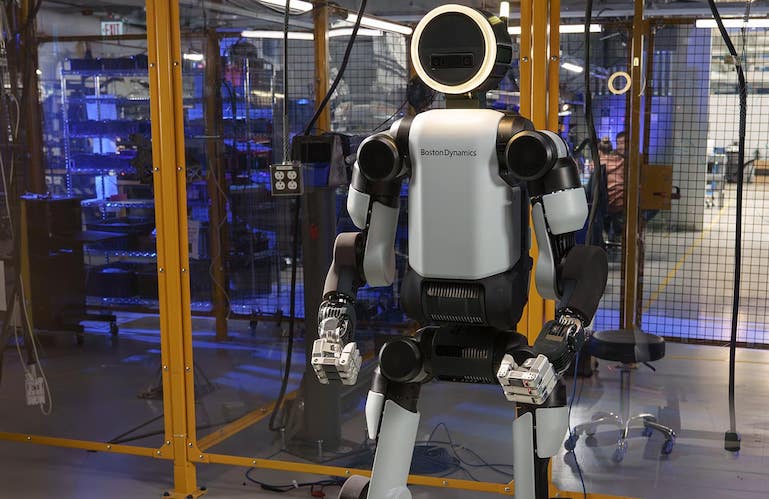
Boston Dynamics’ Atlas robot, powered by cutting-edge AI and NVIDIA chips, is breaking new ground by autonomously performing tasks on the factory floor. For years, humanoid robots have been a staple of science fiction, but recent advances in artificial intelligence are turning them into reality. As the global race to develop humanoid robots intensifies, companies like Boston Dynamics, backed by major players such as Hyundai and NVIDIA, are leading the charge.
What Happened
Boston Dynamics, a Massachusetts-based robotics company, is at the forefront of humanoid robot development with its Atlas robot. Valued at over $1 billion and owned 88% by Hyundai, Boston Dynamics is pushing the boundaries of what robots can achieve. Atlas, standing at 175 cm tall and weighing 90 kg, has transitioned from a lab prototype to a functional factory worker. Initially, Atlas could only perform basic movements like running and jumping. Now, thanks to advancements in AI and machine learning, it autonomously sorts items for assembly lines without human intervention.
The transformation of Atlas is spearheaded by Zach Jackowski, a mechanical engineering expert from MIT. The robot's development involves innovative training methods, including supervised training where human operators guide Atlas’s movements using virtual reality. This data is then used to train the robot’s AI models, enabling it to perform tasks independently. The process involves extensive simulations where digital versions of Atlas are subjected to various challenges to hone their skills.
What This Means for Your Business
The integration of humanoid robots like Atlas into the workforce has significant implications for the AECM industry. These robots can potentially improve efficiency and productivity by taking over repetitive or dangerous tasks, allowing human workers to focus on more skilled activities. For companies involved in manufacturing, construction, and engineering, the adoption of humanoid robots could lead to cost savings and enhanced operational capabilities.
From a compliance perspective, businesses must consider the implications of integrating AI-driven robots into their operations. This includes adhering to cybersecurity frameworks such as CMMC and NIST, especially when dealing with sensitive data and autonomous systems. Additionally, companies should evaluate the return on investment of deploying humanoid robots and assess how these technologies can enhance their competitive positioning in the market.
What US Operators Should Watch
As humanoid robots continue to evolve, US operators should keep an eye on federal regulations and standards governing the use of AI and robotics. Understanding procurement timelines and funding opportunities for robotics integration will be crucial for staying ahead in the industry. Additionally, companies should monitor advancements in AI technologies and consider partnerships with leading robotics firms to leverage new capabilities.
Is your firm ready for what’s next?
VisioneerIT helps AECM and government contractors modernize operations, achieve compliance, and implement AI.
Explore VisioneerIT Solutions →