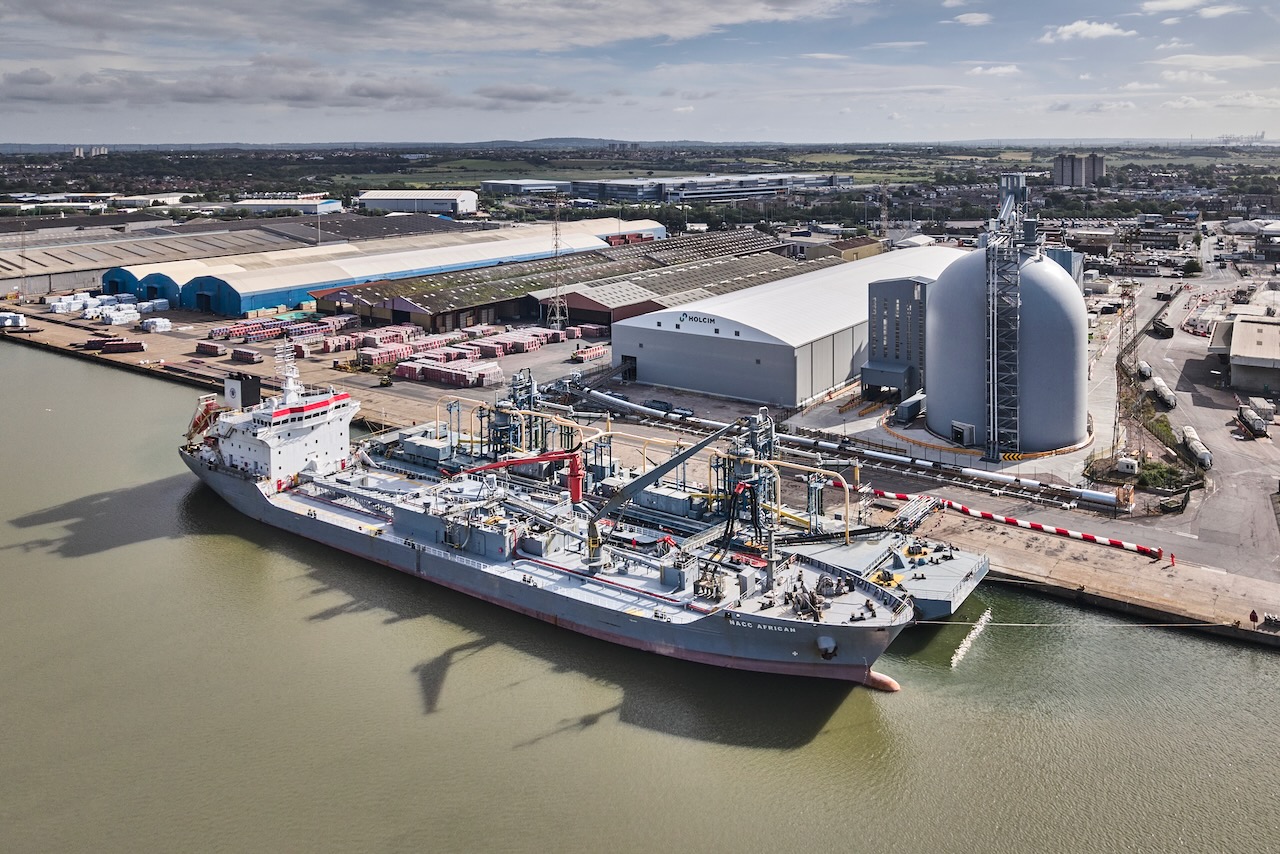
Holcim's Tilbury Cement Works has commenced its first import from a deep-sea vessel, marking a significant milestone in its operation. This move is set to reshape cement supply chains in one of the United Kingdom’s most demanding regions, coinciding with major infrastructure projects like the Lower Thames Crossing.
What Happened
Holcim's new facility at the Port of Tilbury has initiated the import and distribution of cementitious materials. This development is crucial for the South East of England, an area with a high demand for construction materials. The strategic location at Tilbury offers deep-water marine access, large-scale storage, and automated logistics, enhancing supply chain resilience and minimizing reliance on long-distance inland transport. The facility features the UK's first 30,000-tonne cement dome silo and will utilize a new ship-to-shore conveyor system for efficient material transfer.
The construction of this terminal has followed circular principles, utilizing 25,000m³ of crushed concrete and 10,000 tonnes of reclaimed asphalt in its build process. The site is set to complete its vertical roller mill (VRM) by 2026, which will grind granulated blast furnace slag (GBFS) and recycled concrete fines (RCF), supporting the production of low-carbon cement options like Holcim’s ECOPlanet range.
What This Means for Your Business
For AECM professionals and government contractors, the Tilbury Cement Works represents a pivotal development in securing a reliable supply of both conventional and low-carbon cementitious materials. As the facility moves towards full operations, expected by early 2027, businesses can anticipate enhanced procurement options for sustainable building materials. This advancement aligns with the UK's broader shift towards lower-carbon construction, providing opportunities for companies to integrate more sustainable practices and materials into their projects.
Additionally, Holcim's investment in automated logistics and deep-water access could lead to cost efficiencies and reduced freight emissions, potentially lowering the overall cost of materials and improving return on investment for construction projects in the region.
What US Operators Should Watch
Key dates to monitor include the completion of the vertical roller mill in 2026 and the full product line launch in early 2027. These milestones will determine the availability of advanced low-carbon materials for procurement. Moreover, the introduction of the NACC Sustament vessel in 2027 will set new standards in sustainable logistics, potentially influencing global shipping practices in the cement industry.
Source: https://www.theconstructionindex.co.uk/news/view/holcim-starts-imports-at-tilbury
Is your firm ready for what’s next?
VisioneerIT helps AECM and government contractors modernize operations, achieve compliance, and implement AI.
Explore VisioneerIT Solutions →