The rapid development of artificial intelligence (AI) has unveiled a fundamental challenge for the AECM sector: the computational limitations of embodied AI systems. As AI technologies like large language models (LLMs) and multimodal models transition from data centers to physical applications in robotics, the industry faces a critical juncture.
What Happened
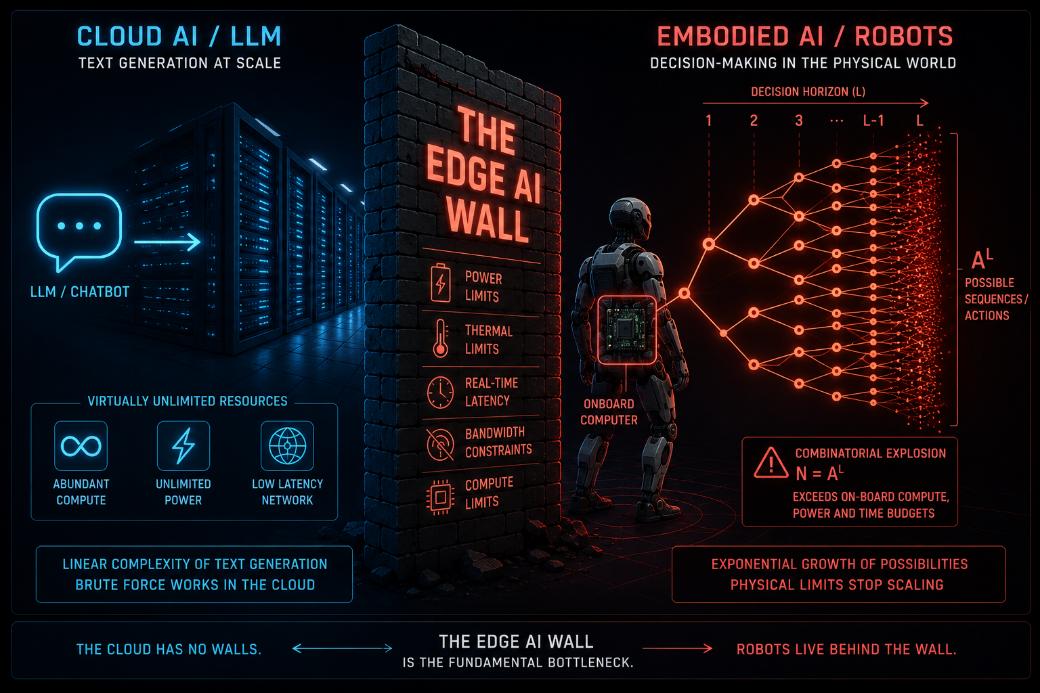
The latest advancements in AI have prompted a shift towards integrating sophisticated models into autonomous systems, such as humanoid robots and self-driving vehicles. However, a growing concern has emerged: the "edge AI wall." This term refers to the computational instability that occurs when AI systems must process increasingly complex environments in real time. Unlike cloud-based AI, which benefits from scalable computing power, physical AI systems are constrained by hardware limitations, including battery life and thermal management.
The issue originates from the exponential growth in solution spaces as tasks become more complex. When a robot's onboard computer struggles to process the environment quickly enough, it risks responding to outdated data, leading to instability and potential accidents. This computational overload is not just a localized problem but a systemic barrier affecting the entire class of physical AI systems.
What This Means for Your Business
For businesses in the AECM industry, the implications are significant. As AI-driven autonomous systems become more prevalent, companies must navigate the challenges of integrating these technologies with existing infrastructure. The limitations of current hardware solutions may necessitate investment in new computational frameworks or advanced mathematical models to maintain system stability and efficiency.
Additionally, the economic viability of scaling onboard computing resources is in question. Companies may need to explore innovative approaches to balance computational demands with physical constraints, ensuring that AI systems remain cost-effective and reliable in real-world applications.
What US Operators Should Watch
Industry stakeholders should monitor developments in computational mathematics and AI architecture closely. Upcoming events, such as the RoboBusiness 2026 conference on October 20, will address these challenges, providing a platform for discussing potential solutions and collaboration opportunities.
Furthermore, as AI integration in physical systems progresses, companies should stay informed about evolving compliance requirements and standards, such as the Cybersecurity Maturity Model Certification (CMMC), to ensure their operations remain secure and compliant with federal regulations.
Is your firm ready for what’s next?
VisioneerIT helps AECM and government contractors modernize operations, achieve compliance, and implement AI.
Explore VisioneerIT Solutions →