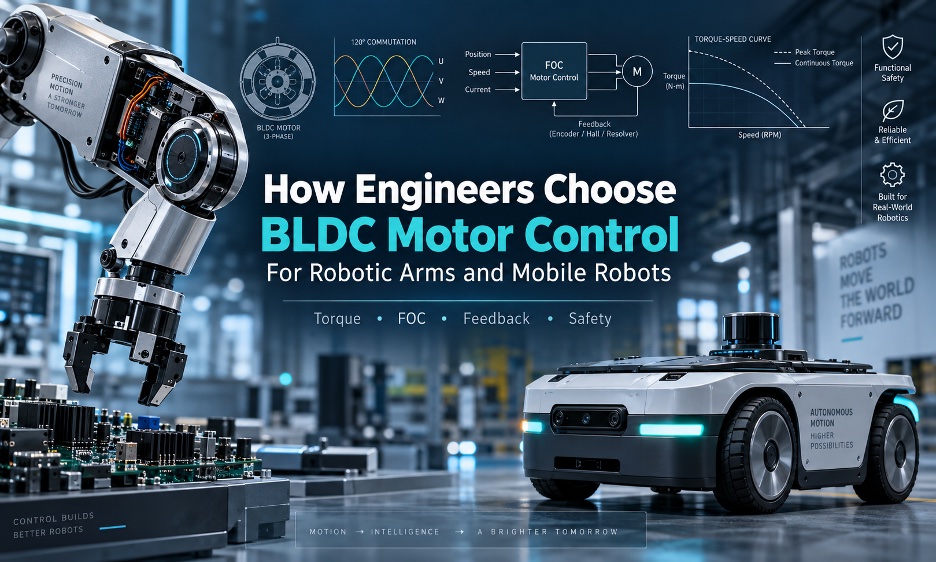
Brushless DC motors (BLDC) are critical to the performance of robotic arms and mobile robots. Selecting the right motor involves a complex interplay of mechanical, electrical, and software considerations, making it an essential task for engineers and decision-makers in the robotics industry.
What Happened
The Robot Report highlights the importance of selecting BLDC motors based on the mechanical system rather than just the controller specifications. The choice of motor affects torque delivery, position accuracy, thermal management, and energy efficiency, all crucial for the performance of robotic systems. Engineers must consider factors such as torque requirements, thermal duty cycles, and regenerative energy absorption when choosing a motor. For robotic arms, controllable torque, low-speed smoothness, and thermal performance are priority considerations, whereas mobile robots emphasize efficiency, starting torque, and battery utilization.
The article explains that terms like BLDC and PMSM (permanent magnet synchronous motor) are often used interchangeably, though their performance can differ based on the back EMF waveform, winding design, and control algorithms. Both types are three-phase, permanent-magnet machines driven by electronic inverters, but their application specifics vary greatly.
What This Means for Your Business
For businesses involved in robotics, particularly those in AECM and government contracting, understanding the nuances of motor selection can lead to better-performing robots and more efficient operations. This knowledge can directly impact procurement strategies, ensuring that the right components are chosen to meet specific performance requirements. Additionally, optimizing motor selection can enhance competitive positioning by improving the overall reliability and efficiency of robotic systems.
The focus on mechanical load and power requirements rather than just catalog specifications can lead to significant cost savings and improved return on investment (ROI). By ensuring motors meet the exact needs of the application, companies can avoid over-specification and unnecessary expenditure, as well as reduce the risk of failures due to inappropriate component selection.
What US Operators Should Watch
Decision-makers should keep an eye on developments in motor technology and control algorithms that can enhance the performance and efficiency of their robotic systems. Staying informed about advances in regenerative braking strategies and energy management can also provide a competitive edge. For government contractors, compliance with evolving standards related to motor control and energy efficiency will be crucial to maintaining eligibility for federal contracts and funding opportunities.
With the robotics field rapidly evolving, staying updated on the latest best practices in motor selection can provide strategic advantages in both commercial and defense applications.
Source: https://www.therobotreport.com/how-to-choose-bldc-motor-robotic-arms-mobile-robots/. Read the original story ->
Partner Insight · VisioneerIT
Understanding the nuances of motor selection is crucial for companies looking to secure government contracts in the robotics sector. VisioneerIT can assist technology firms in navigating federal compliance standards to enhance their competitive positioning.
Win government contracts and meet federal compliance standards. →
Is your firm ready for what’s next?
VisioneerIT helps AECM and government contractors modernize operations, achieve compliance, and implement AI.
Explore VisioneerIT Solutions →