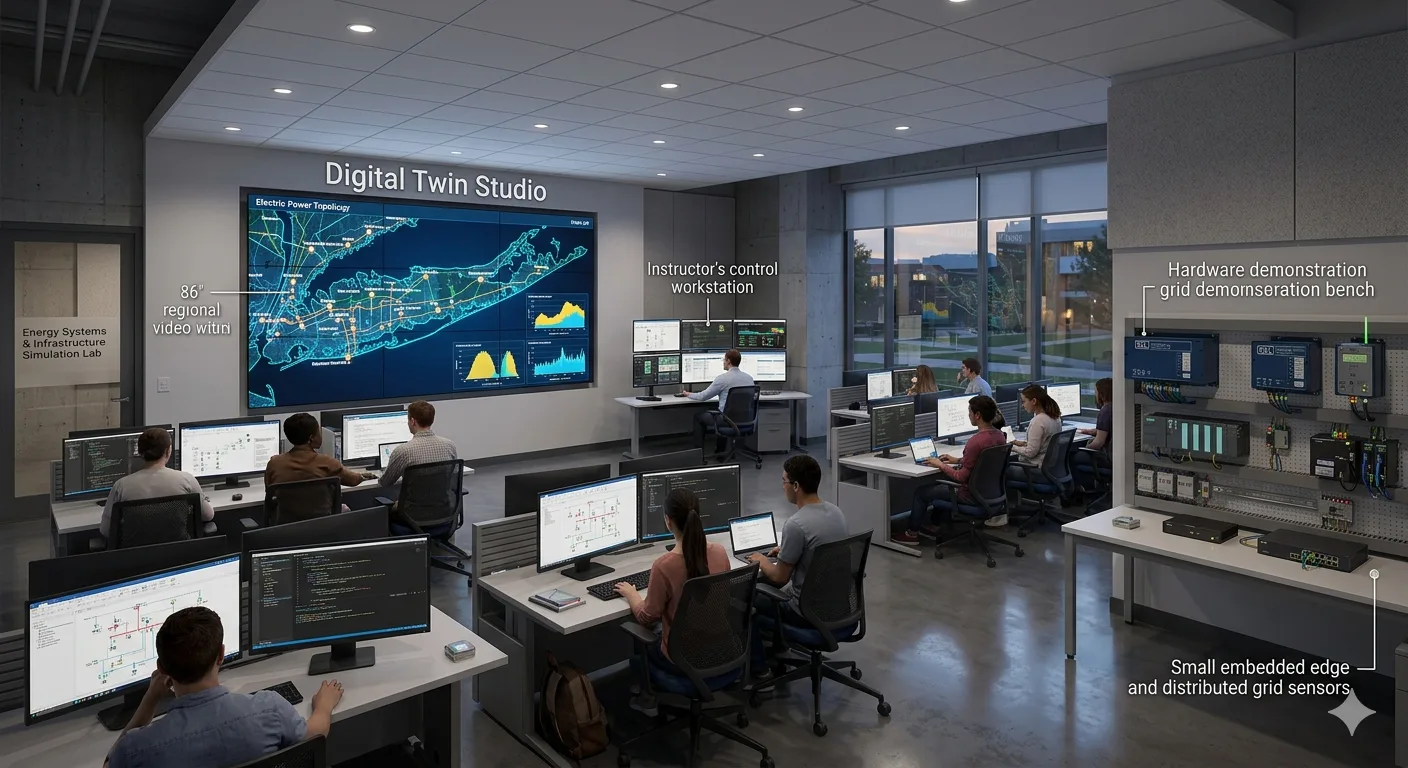
Stony Brook University is pioneering a Digital Twin Studio aimed at bolstering power grid resilience, a crucial advancement as energy systems face increasing demands from electric vehicles and renewable technologies. This initiative is vital for utilities and public agencies, offering a virtual environment to simulate and test grid responses to various challenges, from extreme weather to cyber threats.
What Happened
Stony Brook University, part of the State University of New York system, is constructing a state-of-the-art Digital Twin Studio under the leadership of its Center for Grid Innovation Development and Deployment (GrIDD) at the Advanced Energy Research and Technology Center (AERTC). Announced on September 14, 2026, the project has already secured $550,000 in funding, with an additional $300,000 expected for future development. The studio aims to reach its first operational milestone by December 2026 with a minimum viable platform. This facility will provide high-fidelity virtual models of neighborhood-scale power distribution networks, integrating data from diverse sources such as geographic information systems, weather forecasts, and advanced metering infrastructure. These models will enable users to predict grid performance and resilience before implementing physical changes.
The Digital Twin Studio will initially focus on three key areas: vegetation risk analytics, outage and contingency forecasting, and asset-health monitoring. The vegetation management component will utilize AI, LiDAR, and multispectral data to assess risks posed by encroaching vegetation on electrical infrastructure. This capability is crucial for utilities to prioritize maintenance and prepare for natural disasters like storms and wildfires. The studio will also provide a controlled environment for testing power-flow scenarios, restoration strategies, and the integration of distributed energy resources. Furthermore, asset-health monitoring will extend the digital twin's capabilities to individual devices, using sensors and AI to optimize maintenance and operational efficiency.
What This Means for Your Business
For AECM professionals and government contractors, the development of the Digital Twin Studio at Stony Brook University represents a significant opportunity to engage with cutting-edge grid resilience research and technology. The studio's capabilities could lead to new contracts and partnerships with utilities and public agencies seeking to enhance their infrastructure's resilience. The use of digital twins in testing and simulation reduces the risk and cost associated with physical infrastructure changes, offering a compelling return on investment for operators. Moreover, the integration of AI and high-performance computing in grid management aligns with ongoing compliance requirements such as the NIST Cybersecurity Framework and Zero Trust architectures, ensuring that systems remain secure against evolving cyber threats.
What US Operators Should Watch
Industry stakeholders should closely monitor the progress of Stony Brook's Digital Twin Studio, especially as it approaches its initial operational milestone in December 2026. This timeline represents a critical opportunity for AECM professionals to engage early with the technology and explore potential collaborations. Additionally, operators should stay informed about federal funding opportunities that support grid resilience and digital twin technologies, as these could offer financial incentives for adopting similar innovations. Keeping abreast of regulatory developments and compliance requirements related to grid security and resilience will be essential for maintaining competitive positioning in this evolving landscape.
Source: https://zweiglist.com/stony-brook-university-building-digital-twin-studio-to-advance-grid-research-and-resilience/. Read the original story ->
Is your firm ready for what’s next?
VisioneerIT helps AECM and government contractors modernize operations, achieve compliance, and implement AI.
Explore VisioneerIT Solutions →