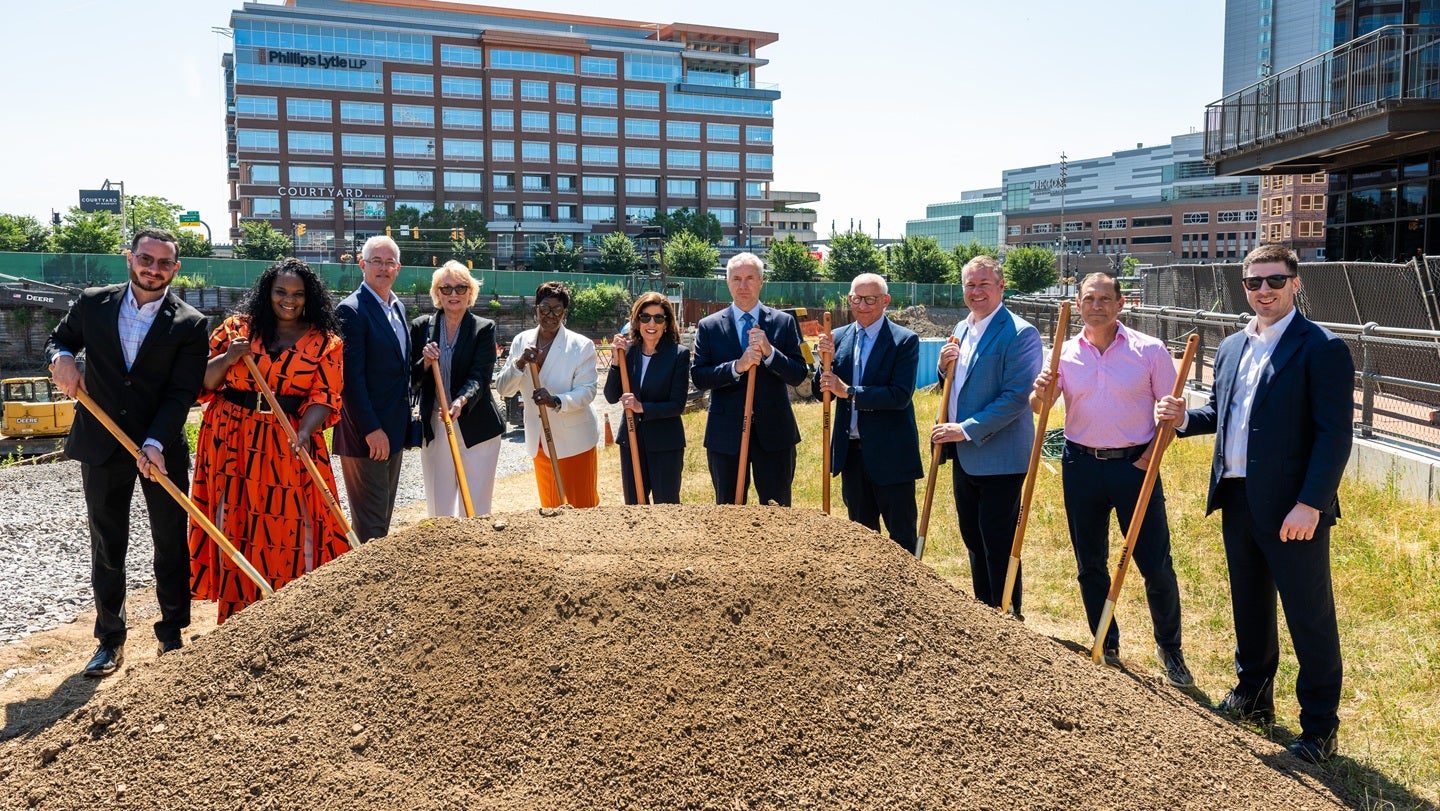
The commencement of construction on the North Aud Block, a $225 million mixed-use development at Buffalo’s Canalside, marks a significant milestone for the city. Announced by Governor Kathy Hochul, this project is set to revitalize a long-vacant area, once home to the Buffalo Memorial Auditorium, which closed its doors in 1996 and was demolished in 2009.
What Happened
The North Aud Block project aims to transform the former site of the Buffalo Memorial Auditorium into a vibrant mixed-use development. It will offer 251 apartments, with 187 units designated as affordable housing for households earning up to 80% of the Area Median Income. The remaining units will be available at market rates. The development will also feature 18,000 square feet of commercial space, a 20,000 square foot community open area, and 137 parking spaces. A public canal-side plaza will be built to connect the development with the Canalside neighborhood and the KeyBank Center, featuring seating and landscaping designed to mitigate wind and retain heat.
Governor Hochul emphasized the importance of this project, stating, "For too long, the North Aud Block has sat in the shadow of Canalside as a vacant reminder of the past, but today we are rewriting its future as a vibrant destination on Buffalo’s historic waterfront."
Developed by Pennrose, the project will cater to a diverse range of residents, incorporating energy-efficient and all-electric features such as heat pumps, ENERGY STAR appliances, and electric vehicle charging stations. The Erie Canal Harbor Development Corporation, a part of Empire State Development, previously owned the site. The project is funded through multiple sources, including over $30 million from the Federal Low-Income Housing Tax Credit program and over $35 million from the State Low-Income Housing Tax Credit program, along with $65 million in subsidies.
What This Means for Your Business
For AECM professionals and government contractors, the North Aud Block project represents a significant opportunity in urban redevelopment and mixed-use construction. The project's financing model, which includes federal and state tax credits along with subsidies, highlights the importance of leveraging public-private partnerships in large-scale developments. The focus on affordable housing and sustainable building practices aligns with current industry trends and regulatory requirements, particularly in energy efficiency and compliance with environmental standards.
The inclusion of accessible units also sets a precedent for compliance with accessibility standards, which could influence future projects. Additionally, participation in the New York State Brownfield Cleanup Program could make the project eligible for approximately $20 million in further tax credits, offering a model for integrating environmental remediation with urban development.
What US Operators Should Watch
US operators should monitor the timeline for tax credit applications and subsidies associated with projects like the North Aud Block. Staying updated on federal and state funding opportunities, such as the Low-Income Housing Tax Credit programs, can provide competitive advantages in securing project financing. Additionally, keeping an eye on accessibility regulations and energy efficiency standards will be crucial as these elements become increasingly integral to securing contracts and ensuring project compliance.
For decision-makers, understanding the implications of public-private partnerships and the strategic use of tax credits and subsidies will be essential for competitive positioning in the market.
Source: https://www.worldconstructionnetwork.com/news/construction-begins-mixed-use-ny/
Is your firm ready for what’s next?
VisioneerIT helps AECM and government contractors modernize operations, achieve compliance, and implement AI.
Explore VisioneerIT Solutions →