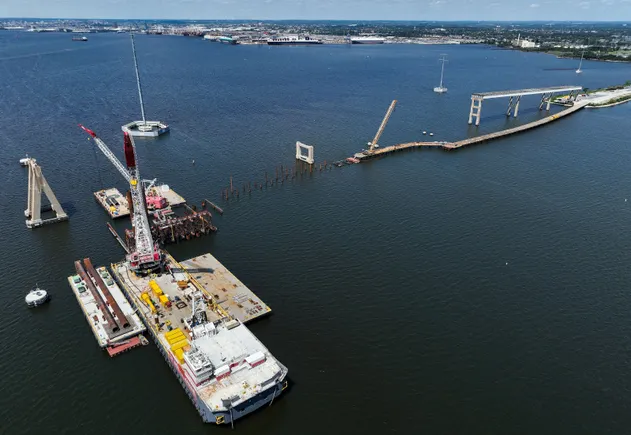
The Maryland Transportation Authority (MDTA) has taken a significant step in the ambitious $4 billion reconstruction of the Francis Scott Key Bridge by awarding a $38.6 million demolition contract to Joseph B. Fay Co. The Pittsburgh-based contractor will tackle the complex task of removing remnants of the bridge that collapsed in March 2024, a pivotal project in the broader redevelopment strategy.
What Happened
The contract, announced on November 20, 2026, involves comprehensive demolition and marine work, including the removal of steel structures spanning the Patapsco River and the demolition of 10 piers from the former bridge. Joseph B. Fay Co. will also clear nine marine foundations and prepare 96-inch-diameter steel pipe piles for the new bridge's construction. This contract is one of four significant procurements planned to replace the Key Bridge, with the entire project estimated to cost between $4 billion and $4.8 billion. The MDTA selected Joseph B. Fay Co. as the lowest-priced qualified bidder.
What This Means for Your Business
For businesses in the architecture, engineering, construction, and manufacturing (AECM) sectors, this contract award signifies a robust opportunity in the Maryland infrastructure market. The Key Bridge project, with its multi-billion dollar scope, presents numerous procurement and subcontracting opportunities. Companies involved in marine construction, steel manufacturing, and environmental remediation stand to benefit from the various phases of this large-scale project. Furthermore, the emphasis on cost-effective bidding underscores the competitive nature of government contracts, which necessitates strategic pricing and robust compliance with federal and state regulations.
What US Operators Should Watch
Key timelines and procurement windows are crucial for stakeholders. The next significant milestone is the South Land Approach contract, anticipated to be advertised in the coming months, with construction slated to commence in spring 2027. Firms aiming to participate must prepare to meet stringent compliance standards and deadlines, particularly those related to the Cybersecurity Maturity Model Certification (CMMC) and NIST guidelines. Keeping abreast of federal funding allocations and infrastructure bills will also be essential for securing future opportunities in this and other infrastructure projects.
Source: Construction Dive
Is your firm ready for what’s next?
VisioneerIT helps AECM and government contractors modernize operations, achieve compliance, and implement AI.
Explore VisioneerIT Solutions →