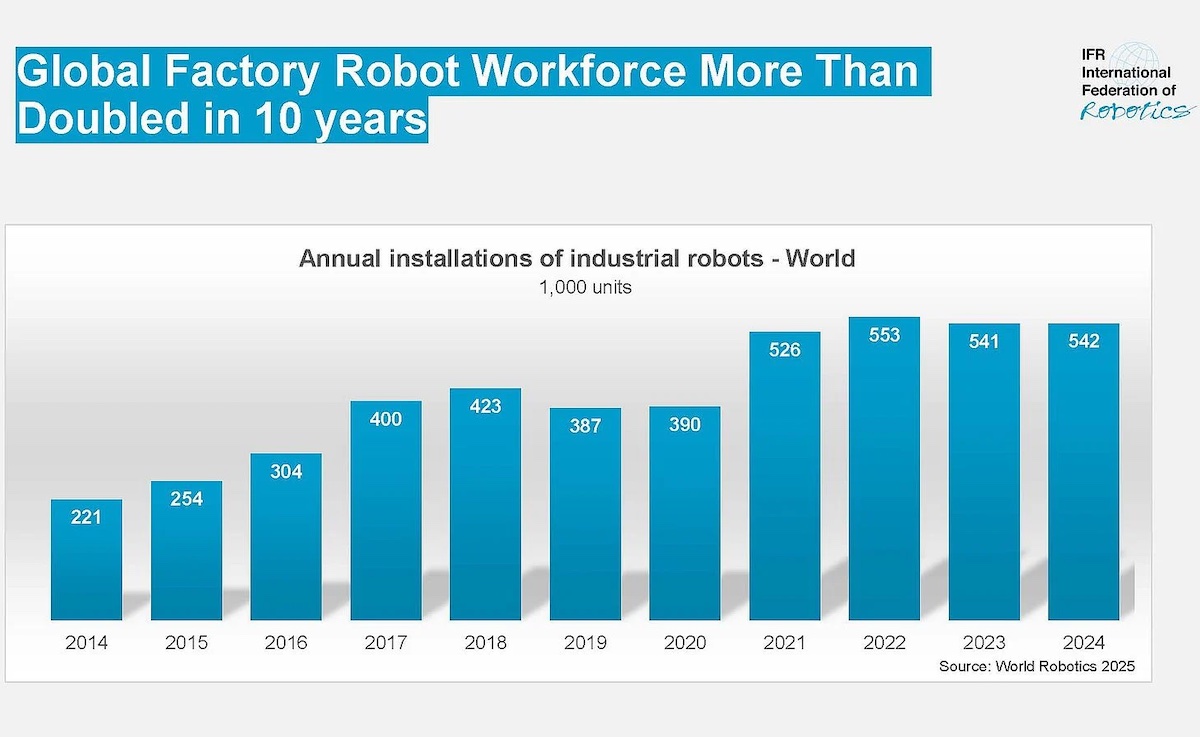
Industrial robot adoption has been on the rise, with significant implications for U.S. AECM professionals. The International Federation of Robotics (IFR) reported that in 2024, 229,000 robotic systems for industrial use were sold globally, with 70% of these sales concentrated in Japan, China, the U.S., Germany, and the Republic of Korea. As robotics become more integral to industrial processes, U.S. companies face both opportunities and challenges in leveraging these technologies.
What Happened
The IFR's data highlights a robust increase in industrial robotics sales, underscoring the strategic importance of robotics in major economies. In 2024, the U.S. was one of the top five countries driving this growth, though it relies more on private capital than federal funding to support its robotics industry. Globally, over 343 companies manufacture industrial robots, and more than 347 integrate robotic systems into production processes. Service robots have also gained traction, with sales for professional use reaching 24,207 units last year, accounting for 11.5% of total sales, while personal use robots saw sales of 4.7 million units.
The IFR predicts continued growth across all robotics market segments, with industrial robot sales expected to hit 400,000 units and service robots for professional use projected to reach 152,375 units, generating $19.6 billion in revenue. Personal use service robots are estimated to reach 35 million units and $12.2 billion in sales. By 2030, Myria Research projects the robotics market, alongside intelligent operating systems, to exceed $380 billion.
What This Means for Your Business
For U.S. AECM professionals, the rise in robotics adoption presents significant procurement and competitive opportunities. Companies can capitalize on the increasing automation trends by integrating robotics into their operations, potentially improving efficiency and reducing costs. However, the reliance on private capital suggests a need for strategic partnerships and investment to stay competitive. The growing market also opens avenues for innovation in robotics technologies, particularly in areas like energy harvesting, self-repairing robots, and swarm intelligence.
Compliance with evolving standards such as CMMC and NIST remains critical as companies adopt new technologies. Moreover, the mixed workforce model, where robots, AI, and humans collaborate, necessitates new management strategies and potentially the creation of executive positions to oversee these integrated systems.
What US Operators Should Watch
Key challenges include a weak educational infrastructure and a shortage of qualified robotics specialists, which could hinder growth. U.S. operators should advocate for improved training programs and a more streamlined research funding mechanism to overcome bureaucratic obstacles. Additionally, understanding international market demands and proprietary technological solutions will be crucial for maintaining a competitive edge.
The upcoming years will be pivotal for robotics integration, with significant federal funding opportunities and procurement windows likely to emerge. AECM professionals should monitor these developments closely to align their strategies with the broader industry trajectory.
Source: https://www.therobotreport.com/modernizing-global-economy-industrial-robotics-needed-not-inevitable/. Read the original story ->
Is your firm ready for what’s next?
VisioneerIT helps AECM and government contractors modernize operations, achieve compliance, and implement AI.
Explore VisioneerIT Solutions →