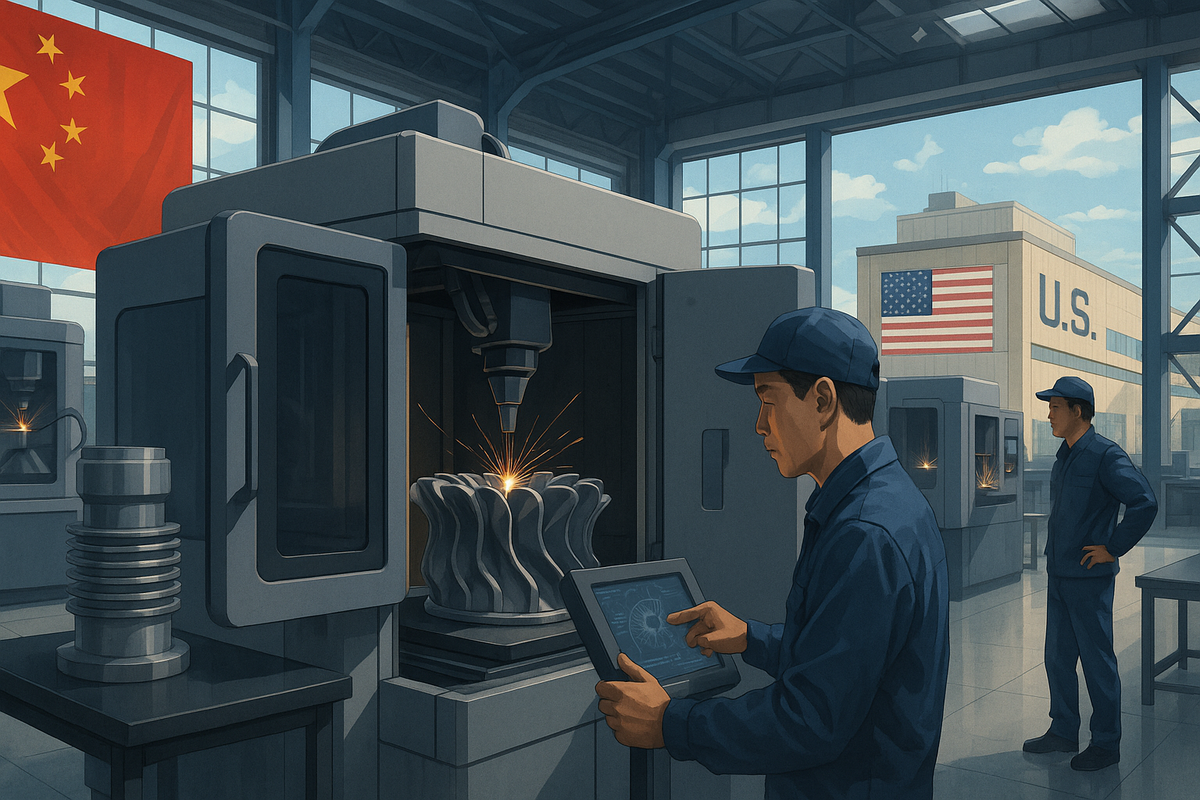
China's rapid expansion in 3D printing technology is reshaping global markets, particularly in aerospace and robotics, posing a significant challenge to U.S. manufacturing sectors. With over 90% of the world's entry-level 3D printers originating from China, this industrial shift underscores a broader strategic pivot by China to leverage 3D printing as a cornerstone of its manufacturing prowess.
What Happened
China has emerged as a powerhouse in the 3D printing industry, producing the vast majority of entry-level 3D printers worldwide. This development is not merely about manufacturing capacity—it signifies China's strategic emphasis on integrating advanced manufacturing technologies into its industrial base. The surge in China's 3D printing capabilities supports its broader goals of dominating high-tech sectors like aerospace and robotics. The country's focus on 3D printing extends beyond mass production to include high-value applications such as aerospace components and robotic parts, which are crucial for maintaining competitive advantages in these fields.
What This Means for Your Business
For U.S. businesses, particularly those in the aerospace and defense sectors, China's dominance in 3D printing presents both a challenge and an opportunity. On the one hand, U.S. companies must contend with increased competition from Chinese firms that can produce high-quality products at lower costs. On the other hand, there is an opportunity for U.S. firms to invest in advanced manufacturing technologies and to innovate in product design and supply chain management. Companies should consider integrating 3D printing into their operations to enhance product customization, reduce lead times, and optimize production costs. Furthermore, the shift underscores the importance of compliance with emerging standards and protocols, such as those outlined in the Cybersecurity Maturity Model Certification (CMMC) and National Institute of Standards and Technology (NIST) guidelines, to ensure data integrity and security in the adoption of these technologies.
What US Operators Should Watch
U.S. operators should closely monitor federal initiatives and funding opportunities that support advanced manufacturing technologies, including 3D printing. The Department of Defense and other federal agencies may increase investments in 3D printing to bolster domestic capabilities in critical industries. Businesses should also stay informed about regulatory developments and compliance deadlines related to cybersecurity and technology standards that could impact their operations. Keeping an eye on bid opportunities and procurement windows associated with federal contracts in aerospace and defense will be crucial for maintaining competitive positioning in these sectors.
Source: https://www.msn.com/en-us/news/technology/china-s-3d-printing-surge-reshapes-aerospace-robotics-and-global-markets/ar-AA25JS1h
Is your firm ready for what’s next?
VisioneerIT helps AECM and government contractors modernize operations, achieve compliance, and implement AI.
Explore VisioneerIT Solutions →Tracking the right federal opportunities?
OryonIQ's AI platform monitors agency forecasts, contract awards, and procurement timelines — so government contractors always know what’s coming next.
Try OryonIQ Free →