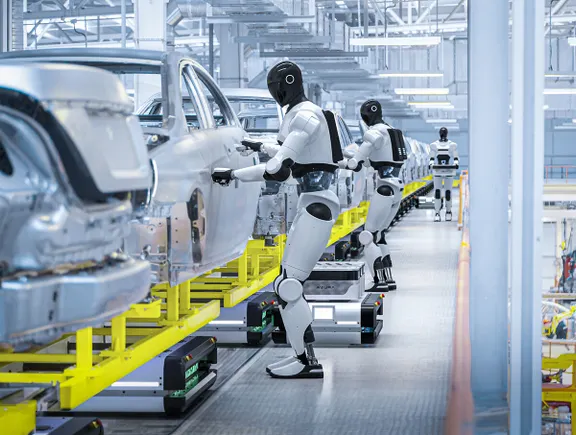
Flexion is spearheading a shift in robotics development, challenging the prevailing reliance on teleoperation for training humanoid robots. Over the past year and a half, the industry has seen substantial financial influx, with billions of dollars funneled into projects that still heavily depend on human operators for data generation. This trend raises critical questions about the sustainability and scalability of current methods.
What Happened
In recent months, companies like Flexion have been at the forefront of developing advanced platforms using reinforcement learning and sim-to-real techniques for humanoid robots. Despite these innovations, the robotics sector continues to rely significantly on teleoperation and human demonstrations to teach AI systems. This approach, although initially promising, has revealed fundamental limitations. Unlike language models that benefit from vast archives of text, robotics must generate every piece of training data through human effort. Consequently, the data available for training robotics is exponentially smaller—over 100,000 times less—than that used for language and vision models. This gap persists because the real world is constantly evolving, demanding new demonstrations for every slight environmental change. The current method of addressing this involves recruiting a labor force, often from lower-wage economies, to generate data. However, this reliance on a continuous stream of human input questions the original goal of humanoid robotics, which was to address labor shortages due to demographic shifts.
What This Means for Your Business
For businesses in the AECM sector, the implications are profound. Embracing teleoperation-centric models may seem like a short-term solution, but it risks creating a dependency on human labor that undermines the long-term promise of robotics. Companies investing in robotics must assess whether their strategies truly advance towards autonomous systems or merely perpetuate a cycle of human dependency. The economic model of continuously hiring operators could inflate operational costs, affecting ROI and competitive positioning. Moreover, the focus should shift towards developing robust AI training methods that reduce reliance on human demonstrations, potentially opening up new avenues for federal funding and innovation grants aimed at fostering AI and robotics advancements.
What US Operators Should Watch
US operators need to watch for emerging technologies that promise genuine autonomy in robotics. Key developments in reinforcement learning and sim-to-real applications, as pursued by companies like Flexion, should be closely monitored. Additionally, keeping track of federal funding opportunities for AI research and development, as well as compliance requirements related to data privacy and labor laws, will be critical. The industry must also prepare for new regulatory frameworks that could emerge as the robotics sector matures and more autonomous solutions are introduced.
Is your firm ready for what’s next?
VisioneerIT helps AECM and government contractors modernize operations, achieve compliance, and implement AI.
Explore VisioneerIT Solutions →