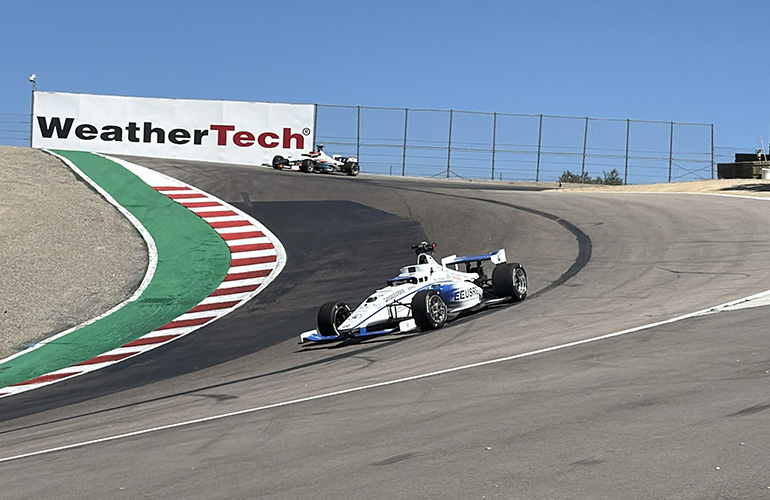
The Indy Autonomous Challenge (IAC) marked a historic moment this September as autonomous racecars successfully overtook each other on a road course at the Laguna Seca Raceway for the first time. This breakthrough in AI-driven racing occurred prior to the Grand Prix of Monterey weekend, underscoring the rapid advancements in autonomous vehicle technology.
What Happened
The latest IAC event, held on September 3, showcased a significant leap in autonomous racing capabilities. For the first time in IAC's history, university teams from across the globe competed in one-on-one heats where the autonomous vehicles not only raced but also overtook each other on the challenging road course of Laguna Seca. The event saw the Unimore Racing team from the University of Modena and Reggio Emilia triumph over Purdue AI Racing in the final heat. The competition involved nine university teams representing North America, Europe, and Asia, each equipped with AV-24s provided by IAC.
The racecars, uniform in their Dallara base design, Honda engines, Luminar sensors, and NVIDIA GPUs, were piloted by AI driver software developed by the teams. This year's event was distinct as it required teams to qualify through a simulation race hosted by D-Space, marking the first instance where virtual testing played a pivotal role in the qualification process. This ensured that each team's algorithms were battle-ready, reducing the risk of on-track collisions.
What This Means for Your Business
The IAC's successful demonstration of autonomous overtaking on a road course signals a pivotal shift towards more complex and nuanced AI applications in real-world scenarios. For businesses in the AECM and government contracting sectors, this advancement presents numerous opportunities and challenges. Companies involved in AI technology, sensor manufacturing, and autonomous systems stand to gain from increased demand for innovative solutions adaptable to a wide range of environments, from construction sites to urban planning.
Furthermore, the emphasis on simulation-based qualification and testing highlights the growing importance of digital twins and virtual environments in reducing development costs and improving safety. This approach aligns with the broader industry trend towards integrating AI and machine learning in predictive maintenance and operational efficiency, offering significant ROI potential.
What US Operators Should Watch
As autonomous technologies continue to evolve, US operators should keep an eye on the regulatory landscape, particularly any changes in compliance standards such as CMMC and NIST guidelines. The success of the IAC could spur new federal funding opportunities aimed at accelerating autonomous vehicle development and deployment. Moreover, companies should prepare for potential procurement windows as the government and private sector increasingly incorporate autonomous systems into their operations.
The IAC's initiative also highlights the importance of fostering talent and innovation through partnerships with academic institutions. Engaging with university research programs and participating in competitions like the IAC can provide access to cutting-edge technologies and a pipeline of skilled engineers and researchers.
Is your firm ready for what’s next?
VisioneerIT helps AECM and government contractors modernize operations, achieve compliance, and implement AI.
Explore VisioneerIT Solutions →