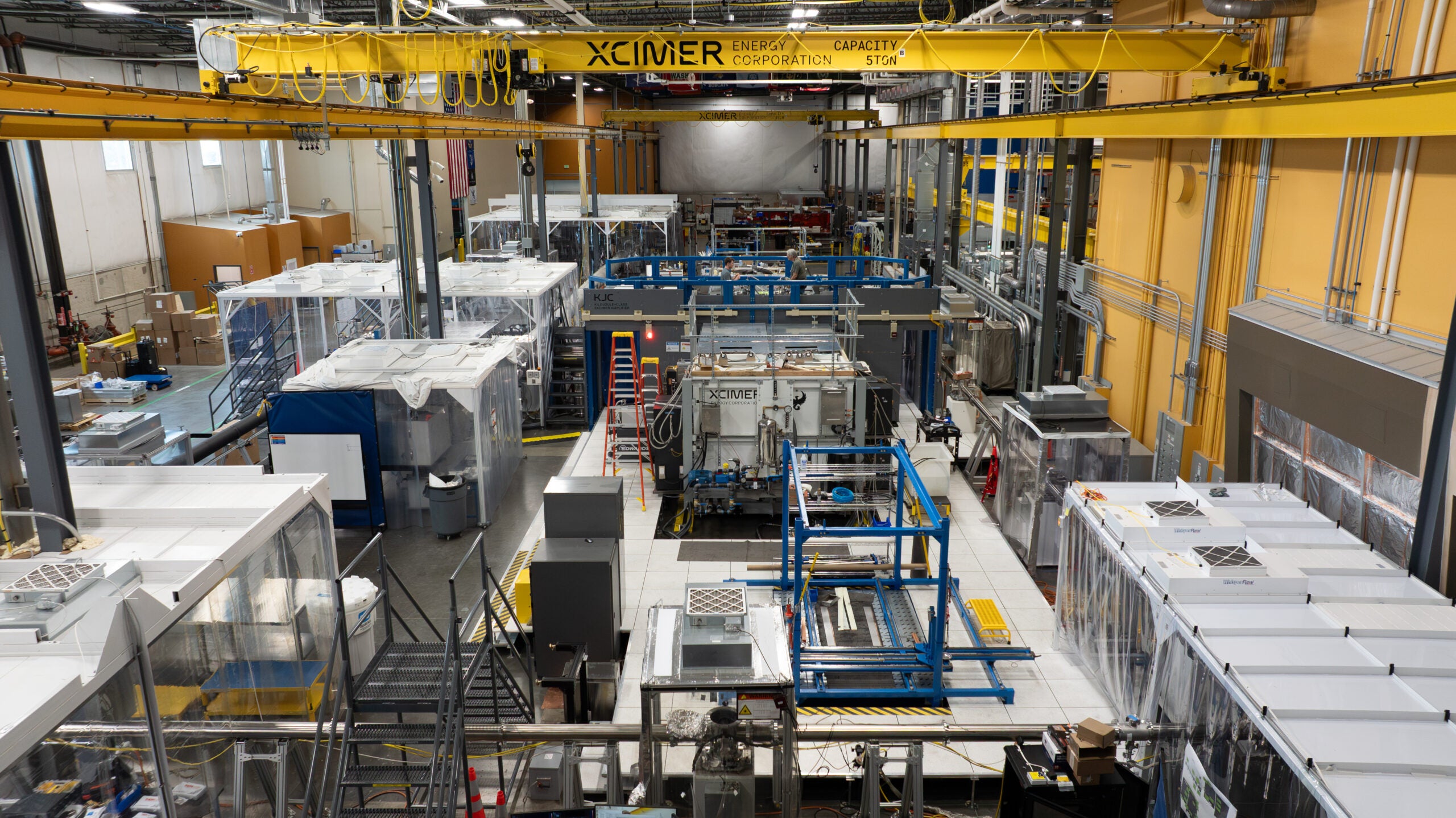
Colorado's Xcimer Energy has commenced operations of Phoenix, touted as the largest privately owned laser system globally, marking a significant milestone in the advancement of laser fusion technology. This development is crucial for the AECM industry, as it represents a potential breakthrough in energy generation that could redefine how businesses approach sustainable power solutions.
What Happened
Phoenix, a prototype laser fusion architecture housed in Xcimer's 74,000-square-foot Denver facility, is a proof of concept for a novel fusion process. Utilizing a krypton fluoride (KrF) excimer laser with Stimulated Brillouin Scattering (SBS), Phoenix compresses a microsecond-long pulse into the nanosecond timescales necessary for fusion. This achievement, announced on June 3, showcases the integrated operation of excimer amplification and SBS pulse compression.
The project is a precursor to Vulcan, which aims to be the world's largest laser, and Athena, envisioned as the first commercial fusion power plant capable of continuous grid-scale electricity generation. Xcimer has rebuilt industrial capabilities around large-scale electron-beam-pumped excimer lasers—a skillset nearly lost after the Cold War. Supported by venture capital and the U.S. Department of Energy, Xcimer assembled expertise from national laboratories, the National Ignition Facility (NIF), and other specialized sectors.
What This Means for Your Business
For AECM professionals, Xcimer's progress signals potential shifts in energy procurement and sustainability strategies. The efficiency and reduced complexity of the KrF excimer lasers—compared to the NIF's costly and maintenance-heavy solid-state glass laser systems—could lower operational costs and enhance ROI for companies investing in this technology. Furthermore, the project's success could unlock federal funding opportunities for firms involved in developing infrastructure for fusion energy deployment.
Compliance with evolving energy regulations and standards, such as those related to zero-emission targets, will also be critical. Companies should prepare for possible future mandates requiring integration of fusion-based energy solutions into their operations.
What US Operators Should Watch
Executives and procurement directors should monitor the development timelines of Vulcan and Athena closely. As Xcimer moves towards commercial viability, staying informed about federal deadlines and procurement windows for fusion energy projects will be essential. Additionally, keeping abreast of updates from the Department of Energy regarding funding and regulatory changes is crucial for strategic planning and competitive positioning.
Is your firm ready for what’s next?
VisioneerIT helps AECM and government contractors modernize operations, achieve compliance, and implement AI.
Explore VisioneerIT Solutions →