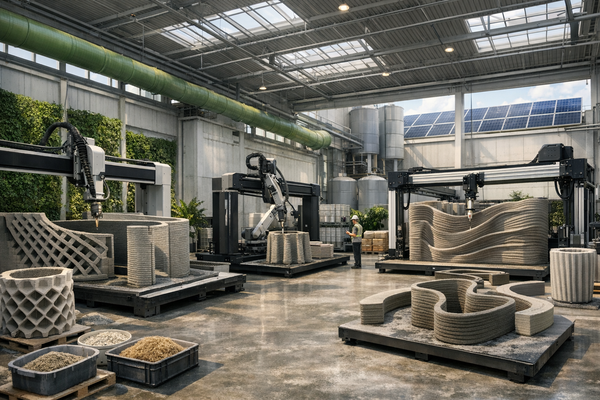
Siemens is at the forefront of a manufacturing revolution, combining Industrial AI with additive manufacturing to create a seamless digital thread from design to production. This integration promises to transform how products are developed and manufactured, offering a new level of flexibility and efficiency.
What Happened
Siemens has unveiled a novel approach that marries Industrial AI with additive manufacturing, enabling a more adaptive and efficient product development process. The company's new Agentic AI workflow allows for prompt-based engineering, which simplifies the task of designing and producing components such as robotic grippers. Users describe the task and object, and the AI orchestrates the necessary engineering steps, from design adaptation to manufacturing preparation. This system reduces the need for manual design iterations, making complex engineering workflows more accessible. Furthermore, Siemens introduces an adaptive production cell that extends this AI-driven approach into the production phase, promising a more responsive manufacturing process.
What This Means for Your Business
For US operators in the AECM industry, Siemens' advancements offer significant opportunities to enhance competitive positioning. By adopting Siemens' AI and additive manufacturing solutions, businesses can streamline their engineering processes, reduce time-to-market, and customize products with greater ease. The integration of AI in manufacturing also aligns with emerging compliance requirements such as CMMC and NIST, providing a pathway to secure, efficient operations. Additionally, leveraging these technologies could open doors to federal funding opportunities aimed at modernizing manufacturing infrastructure, thereby boosting ROI.
What US Operators Should Watch
Decision-makers should closely monitor Siemens' rollout of its Industrial AI and additive manufacturing solutions, as these could become industry standards in the near future. Keeping an eye on updates regarding the adaptive production cell will be crucial, as it represents the next phase of flexible manufacturing systems. Furthermore, staying informed about potential regulatory changes and compliance deadlines related to AI in manufacturing will be vital for maintaining competitive advantage and operational efficiency.
Partner Insight · VisioneerIT
Siemens' integration of AI in manufacturing aligns with the growing need for cybersecurity and compliance in the industry. As businesses adopt these advanced technologies, ensuring robust cybersecurity measures becomes essential to protect sensitive data and maintain compliance with standards like CMMC.
Explore VisioneerIT Cybersecurity →
Is your firm ready for what’s next?
VisioneerIT helps AECM and government contractors modernize operations, achieve compliance, and implement AI.
Explore VisioneerIT Solutions →