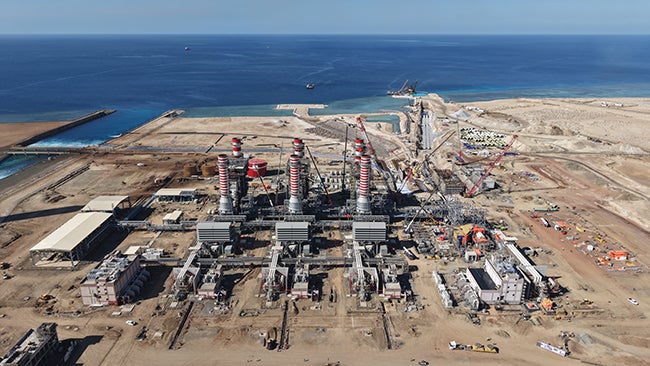
Facing potential supply constraints along the Makkah-Jeddah corridor, Saudi Arabia's power sector has achieved a remarkable feat by compressing the construction schedule of the Rabigh Reinforcement Combined Cycle Power Plant. This acceleration is driven by early alignment, staged authorization, and world-class execution. In July 2025, the first of three gas turbines at the plant was fired, and just four days later, it was synchronized to the grid. This occurred only 14 months after the engineering, procurement, and construction (EPC) contract was awarded, a pace that is extraordinary in the global power sector.
What Happened
The Rabigh Reinforcement project, located on Saudi Arabia’s Red Sea coast in Makkah Province, was developed by the Saudi Electricity Company (SEC) and delivered by a consortium of Siemens Energy and Elsewedy Electric Power Systems Projects (Elsewedy Electric PSP). The 1,179-MW plant is expected to reach full combined cycle completion within 35 months, significantly faster than the typical 40 to 42 months for a plant of this magnitude. The accelerated timeline was vital to meet the high electricity demand during Saudi Arabia’s summer months, especially in the Makkah-Jeddah corridor—a critical load center driven by residential cooling, industrial growth, and religious tourism.
The project was executed under a 25-year Energy Conversion Agreement (ECA) with the Saudi Power Procurement Company (SPPC) as the principal buyer. The EPC contract, valued at approximately SAR 5.33 billion (about $1.4 billion), was awarded in a competitive field. Siemens Energy expanded its role beyond traditional OEM responsibilities, taking on the EPC role, while Elsewedy Electric PSP handled heat recovery steam generators and other critical components.
What This Means for Your Business
For AECM professionals and government contractors, the Rabigh project sets a new benchmark in fast-track project execution. The successful acceleration highlights the importance of early stakeholder alignment and flexible project frameworks that allow work to advance even before final contracts are in place. This approach not only speeds up delivery times but also reduces risks associated with delays, especially in regions with critical power needs. The experience gained from Rabigh could influence future contracts and procurement strategies, emphasizing the need for adaptable logistical operations and integrated delivery models.
For businesses involved in EPC and OEM roles, the Rabigh project demonstrates the potential benefits of expanding service offerings to include broader project management responsibilities. This could lead to new revenue streams and competitive advantages in bid processes.
What US Operators Should Watch
US operators should monitor Saudi Arabia’s evolving power procurement models, particularly the ECA framework, which might offer insights into structuring long-term energy agreements. Additionally, the Rabigh project underscores the importance of rapid deployment capabilities and flexible procurement strategies in meeting urgent infrastructure needs. As the US continues to face its own power infrastructure challenges, the techniques employed in Rabigh could serve as a valuable case study for rapid project execution.
Source: Power Magazine
Is your firm ready for what’s next?
VisioneerIT helps AECM and government contractors modernize operations, achieve compliance, and implement AI.
Explore VisioneerIT Solutions →