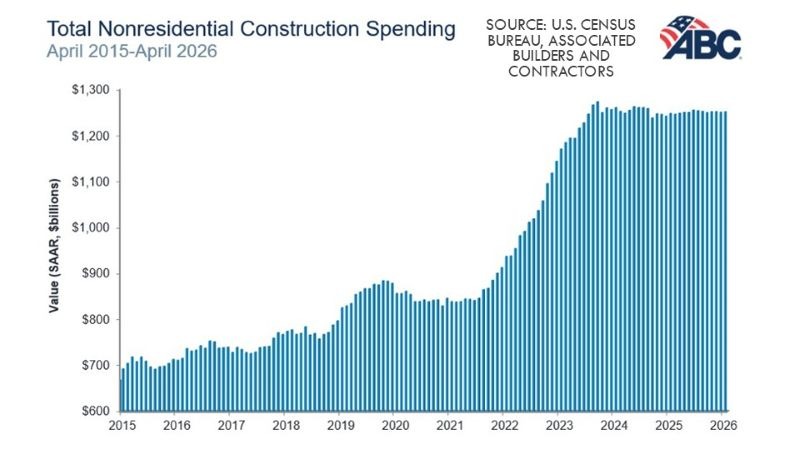
Nonresidential construction spending in the United States experienced a slight uptick of 0.1% in April 2026, reaching a seasonally adjusted annualized rate of $1.250 trillion. This growth, primarily fueled by public sector investments, holds significant implications for stakeholders in the architecture, engineering, construction, and manufacturing (AECM) industries, particularly as private sector spending continues to decline.
What Happened
Nonresidential construction spending rose marginally in April, driven by a 0.4% increase in public sector projects. In contrast, private nonresidential construction spending fell by 0.2%, marking the seventh consecutive month of decline. The data, analyzed by the Associated Builders and Contractors from U.S. Census Bureau statistics, highlights a robust 1.9% growth in spending on data centers, which are categorized under office construction. This segment alone has seen a staggering 28.1% increase over the past year, reaching an annual rate of $50.7 billion.
ABC Chief Economist Anirban Basu pointed out that the overall increase in nonresidential construction spending is largely attributable to public sector activity. The private sector's downturn is partly due to the waning momentum of manufacturing megaprojects incentivized by the CHIPS and Science Act.
What This Means for Your Business
For AECM professionals, the shift in spending patterns underscores the need to pivot strategies towards public sector opportunities. With private sector investments lagging, particularly in manufacturing, firms should consider bolstering their portfolios with public contracts. The continued rise in data center construction suggests a promising niche, especially as demand for digital infrastructure grows. Companies that can adapt to these trends may find competitive advantages and new revenue streams.
Compliance remains a critical concern. As public projects expand, adherence to federal standards, including those set by the Cybersecurity Maturity Model Certification (CMMC) and the National Institute of Standards and Technology (NIST), will be essential. Ensuring robust cybersecurity measures and meeting regulatory requirements could be decisive in securing contracts and maintaining client trust.
What U
Partner Insight · VisioneerIT
As public sector construction projects expand, ensuring compliance with federal standards like CMMC is crucial. VisioneerIT provides comprehensive support for winning government contracts and achieving full CMMC compliance.
Explore VisioneerIT Cybersecurity →
Is your firm ready for what’s next?
VisioneerIT helps AECM and government contractors modernize operations, achieve compliance, and implement AI.
Explore VisioneerIT Solutions →