Manufacturers are increasingly turning away from humanoid robots for surface finishing applications, favoring more efficient and cost-effective industrial robotic solutions. This shift matters now as businesses seek to enhance productivity and reduce costs in labor-intensive manufacturing processes.
What Happened
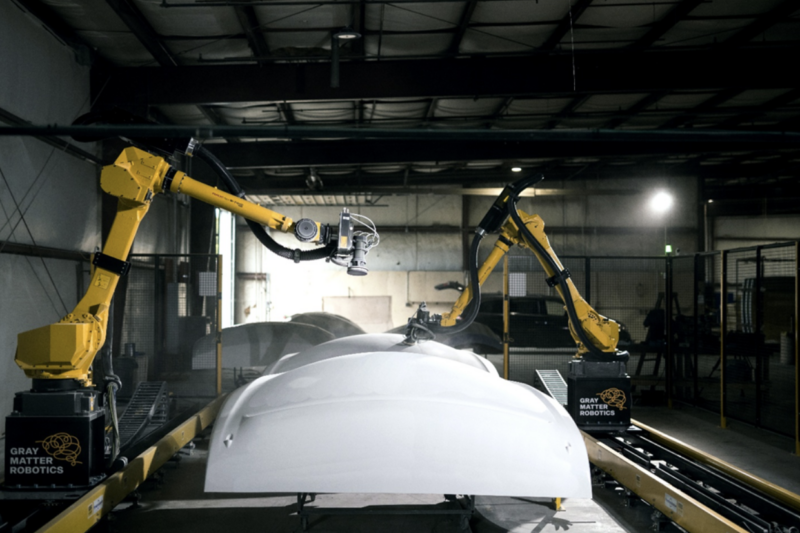
Manufacturing tasks such as sanding, polishing, grinding, and coating are ergonomically challenging and pose health risks to human workers. The industry has considered humanoid robots as potential solutions, but recent evaluations highlight their inefficiencies on factory floors. Humanoids, with their legged locomotion and complex multi-fingered hands, fail to provide the flexibility and cost-effectiveness required for these operations. Legs, in particular, are deemed unnecessary for flat factory floors, adding complexity and safety risks without offering value. In contrast, fixed rails or mobile bases are more effective for repositioning robot arms.
The analysis also indicates that multi-fingered hands, while flexible, do not offer the strong grasp needed for high-speed tool manipulation in manufacturing. Direct tool-arm connections prove more efficient, reducing hardware costs. Additionally, humanoid heads, with limited camera placement, are less effective than sensors mounted on robot arms or strategically placed within the work cell. Instead, dual-arm configurations that maximize workspace and minimize collision risks are preferred.
What This Means for Your Business
For AECM professionals and government contractors, the implications are clear: investing in general-purpose industrial robots rather than humanoid systems could significantly enhance ROI. These robots, capable of operating four to five times faster than humans and applying higher forces, transcend human constraints and are proven reliable in demanding applications. Emphasizing the use of scalable robotic components such as general-purpose arms, rails, and cameras can optimize production cycles and throughput, aligning with industry goals of reducing cycle time and increasing efficiency.
What US Operators Should Watch
Manufacturers should monitor developments in robotic configurations that optimize speed and precision. As the industry moves away from humanoids, the focus should be on integrating industrial robots that align with specific manufacturing needs. Companies should also stay abreast of advancements in robotic arm technology and sensor systems that enhance operational capabilities. Keeping an eye on procurement opportunities for these technologies can provide a competitive edge in the market.
Source: https://www.therobotreport.com/evaluating-humanoids-for-surface-finishing-applications/. Read the original story ->
Is your firm ready for what’s next?
VisioneerIT helps AECM and government contractors modernize operations, achieve compliance, and implement AI.
Explore VisioneerIT Solutions →Tracking the right federal opportunities?
OryonIQ's AI platform monitors agency forecasts, contract awards, and procurement timelines — so government contractors always know what’s coming next.
Try OryonIQ Free →