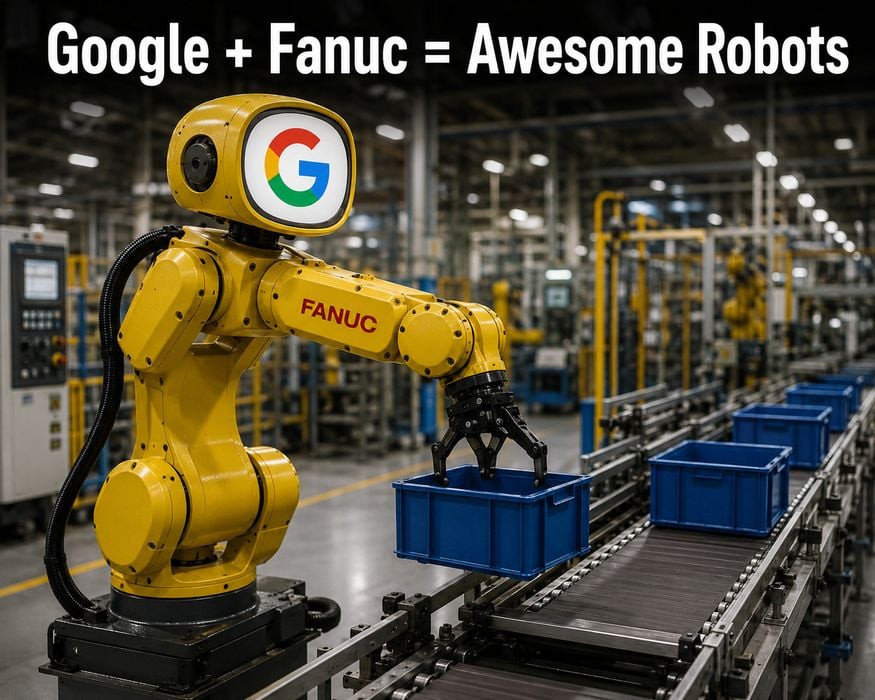
Google and FANUC have announced a groundbreaking partnership to develop "Physical AI" systems, aiming to transform industrial robotics and automation. This collaboration combines Google's AI expertise with FANUC's vast hardware ecosystem, promising a new era of adaptive automation.
What Happened
Google and FANUC's strategic partnership, announced in May 2026, aims to bring "Physical AI" to industrial settings. This initiative leverages Google's advanced AI technologies, such as the Gemini AI models, and FANUC's extensive base of over 1.1 million installed industrial robots. The collaboration focuses on integrating multimodal large language models with robotics, enabling these machines to understand natural language, process real-time computer vision, and perform dynamic sensor fusion. This marks a significant departure from traditional, rigid automation systems, offering a shift towards autonomous and adaptive manufacturing environments.
This partnership signifies a pivotal moment in the industrial robotics landscape. Google's previous attempts to penetrate the robotics hardware market, including its acquisition of Boston Dynamics, did not yield significant commercial success. The robots, while technologically impressive, lacked the intelligence to adapt to unpredictable industrial environments. This time, Google is capitalizing on its core strengths in AI and cloud infrastructure, while FANUC provides the manufacturing reliability and global reach. Together, they aim to overcome the limitations of traditional robotics, enabling machines that can think, adapt, and collaborate more effectively with human workers.
What This Means for Your Business
For businesses in the AECM sector, this collaboration could herald a new era of industrial automation. The integration of AI-driven adaptability in robotics could significantly enhance efficiency and flexibility in manufacturing processes. Companies can expect improved ROI from automation investments, as the need for extensive programming and engineering support diminishes. Additionally, this development could open new avenues in additive manufacturing and flexible tooling environments, reducing costs and increasing production capabilities.
From a compliance perspective, businesses must prepare for potential changes in cybersecurity requirements. As these AI-enabled systems become more prevalent, adhering to standards like CMMC and NIST will be crucial to protect sensitive data. Furthermore, companies should explore federal funding opportunities that support innovation in AI and robotics, positioning themselves advantageously in
Is your firm ready for what’s next?
VisioneerIT helps AECM and government contractors modernize operations, achieve compliance, and implement AI.
Explore VisioneerIT Solutions →Tracking the right federal opportunities?
OryonIQ's AI platform monitors agency forecasts, contract awards, and procurement timelines — so government contractors always know what’s coming next.
Try OryonIQ Free →