![IB_KEY_FACTS:[{"stat":"7","label":"Test Participants","sublabel":"Legally blind individuals navigated with the robotic guide dog in trials."},{"stat":"2026","label":"Robotics Summit & Expo","sublabel":"Event to feature sessions on embodied and physical AI in Boston."}]](https://www.industrialbriefs.com/favicon.png)
Scientists at Binghamton University have developed a groundbreaking robotic guide dog that not only walks but talks, offering visually impaired individuals enhanced navigation capabilities through real-time verbal feedback. This innovation promises to redefine mobility assistance by integrating advanced language models like GPT-4 into robotic systems.
What Happened
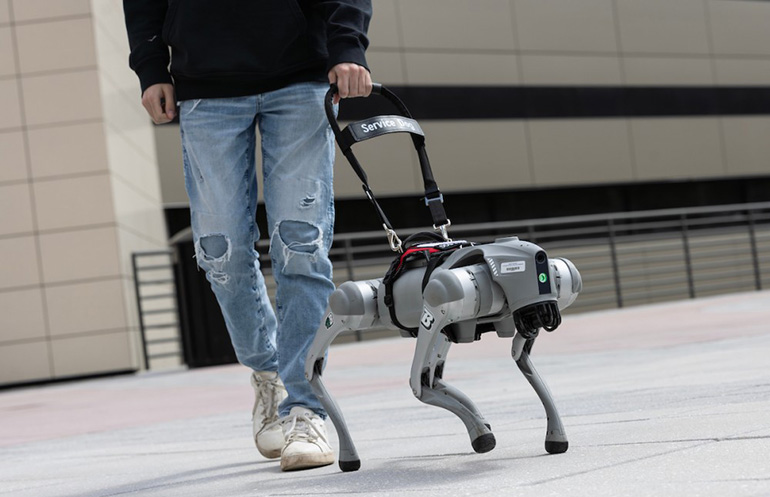
Researchers at Binghamton University, part of the State University of New York, have introduced a robotic guide dog that communicates verbally with users, thanks to large language models (LLMs). The system, developed by Shiqi Zhang and his team, can determine optimal routes and provide real-time feedback during travel. This technological leap allows the robot to offer a level of interaction far beyond what biological guide dogs can achieve, which typically understand around 20 commands. The robotic guide dog can engage in a dialogue with the user, offering route information before departure and ongoing situational updates during the journey.
The research team conducted trials with seven legally blind participants in a large office setting. The robot guided users to a specified destination, such as a conference room, while narrating the environment and alerting them to obstacles. Participants rated the system highly for its helpfulness and ease of communication. This approach to robotic guide dogs has also been explored by other institutions, including the University of Glasgow and Glidance, a past RoboBusiness Pitchfire winner.
Why It Matters for the AECM Industry
The development of robotic guide dogs with advanced communication capabilities has significant implications for the AECM industry. For architects and urban planners, integrating such technology into public spaces could enhance accessibility standards, leading to more inclusive designs. Construction professionals might see new opportunities in retrofitting existing structures to accommodate robotic assistants, potentially driving demand for specialized materials or design solutions.
For manufacturers, this development could spur innovation in robotics and AI integration, pushing the boundaries of what's possible in assistive technology. The use of LLMs in robotics suggests a growing trend towards more intelligent, autonomous systems that can adapt to complex environments, a shift that could redefine production lines and supply chain logistics.
Moreover, the successful implementation of such technology could influence regulatory frameworks, prompting updates to building codes and accessibility laws. This would require AECM professionals to stay informed about evolving standards and adapt their practices accordingly.
What's Next
The Binghamton University team plans to expand their research by conducting more extensive user studies and enhancing the system’s autonomy. Future tests will involve navigating longer distances in various environments, both indoors and outdoors. As the technology matures, AECM professionals should monitor developments in regulatory changes and potential impacts on design and construction practices.
The upcoming Robotics Summit & Expo in Boston on May 27-28, 2026, will feature sessions on embodied and physical AI, offering further insights into the integration of such technologies. Professionals in the field should consider attending to stay abreast of the latest advancements.
Is your firm ready for what’s next?
VisioneerIT helps AECM and government contractors modernize operations, achieve compliance, and implement AI.
Explore VisioneerIT Solutions →