The Allen Institute for AI (Ai2) has unveiled MolmoAct 2, an open-source robotics foundation model aimed at revolutionizing how robots perform real-world tasks. This announcement is a significant development for the Architecture, Engineering, Construction, and Manufacturing (AECM) sectors, where adaptable automation can dramatically enhance efficiency and precision.
What Happened
Ai2, based in Seattle, released the MolmoAct 2 model this week, marking a significant upgrade from its predecessor, the MolmoAct system. The model is designed to address the rigidity of current robotics systems, which are often tailored for specific tasks and environments. MolmoAct 2 leverages an "Action Reasoning Model" architecture, enabling it to reason and act in three-dimensional environments without extensive pre-programming.
The new model is capable of performing complex manipulation tasks, such as bimanual operations like towel folding, object sorting, and table clearing, with greater speed and efficiency. According to Ai2, MolmoAct 2's performance is significantly faster, with adaptive depth reasoning reducing action call times from 6,700 milliseconds in the original MolmoAct to just 790 milliseconds.
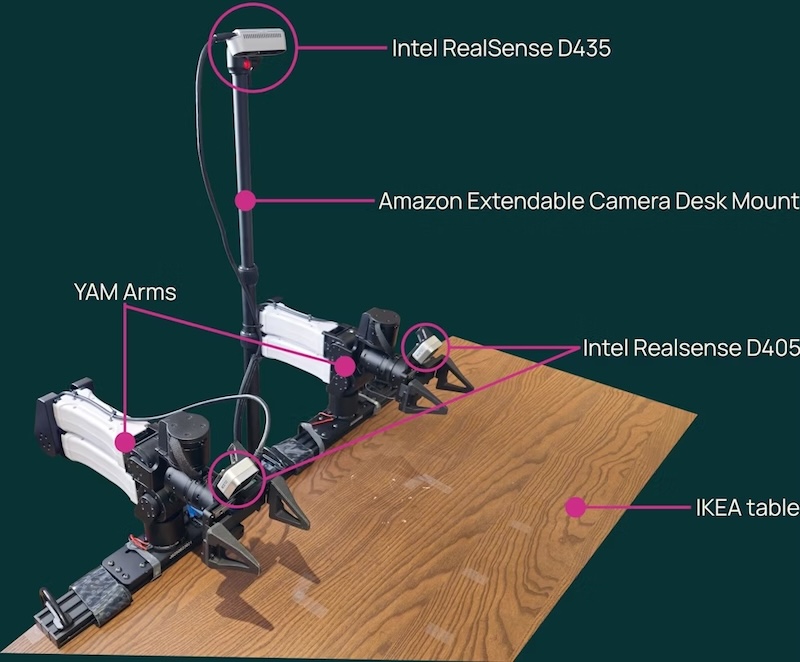
Ai2's commitment to open AI development is evident, as they have released the model's full weights, datasets, and an open-source robotics action tokenizer. The launch also includes the MolmoAct 2-Bimanual YAM dataset, which is touted as the largest open-source dataset for bimanual tabletop manipulation, encompassing over 720 hours of robot demonstrations.
The model has been tested on a Franka robot arm, showing high success rates in tasks like moving objects into bowls and inserting items into confined spaces. It also outperformed competing models in evaluations by Cortex AI.
Why It Matters for the AECM Industry
The introduction of MolmoAct 2 could significantly impact the AECM industry by providing a more flexible and responsive automation solution. For construction and manufacturing, where repetitive tasks are common, the model's ability to perform various operations without extensive reprogramming can lead to reduced labor costs and increased productivity.
Moreover, the model's open-source nature allows for customization and adaptation to specific industrial applications, enabling companies to tailor the technology to their
Partner Insight · VisioneerIT
The advancements in robotics models like MolmoAct 2 highlight the need for robust software engineering to support complex automation tasks. VisioneerIT offers expertise in building scalable software solutions and modernizing legacy systems to enhance operational efficiency.
Explore VisioneerIT Cybersecurity →
Is your firm ready for what’s next?
VisioneerIT helps AECM and government contractors modernize operations, achieve compliance, and implement AI.
Explore VisioneerIT Solutions →